Plan reverse osmosis machine installation · Kenya
Reverse osmosis machine installation starts with your water quality and the amount you need each day. Get a matched RO system for your home, water-refilling business, hotel, school or industrial site, with an itemised quotation and a clear commissioning plan.
Reverse osmosis machine installation: start with your water report
Buying an RO machine before checking the source water can leave you with an expensive system that struggles to produce enough usable water. Two boreholes in the same county can have different treatment needs. County water can also change after storage or mixing with another source. Send a recent water analysis and explain where the sample came from. We use that information to discuss the treatment duty before recommending equipment.
Tell us what the treated water will be used for. Drinking water, a hotel kitchen, a water-refilling shop and a manufacturing process can need different quality targets. A low TDS reading alone does not establish that water is safe to drink. Physical, chemical and microbiological results matter, together with the condition of storage tanks and distribution pipework. Ask the laboratory which sampling containers and handling instructions apply to the tests you need.
Information that makes your quotation useful
Share your county, nearest town, location pin, source-water report and daily demand in litres. Include available power, existing tank capacities, expected operating hours and photographs of the proposed treatment room. If you already have a plant, send its model label, membrane references and recent operating readings. Missing information is fine: tell us what you have so that the quotation identifies any assessment still needed.
For a borehole supply, separate the pumping duty from the treatment duty. The borehole pump must deliver the required feed flow without exceeding the borehole’s sustainable yield. RO produces treated water and a reject stream, so its feed requirement exceeds its product-water output. Our pumping assessment and pump-sizing service can help establish the upstream supply where records are missing.
Size the plant for daily demand, operating hours and recovery
A catalogue rating in litres per hour is a starting point, not a promise of daily production at every site. Start with the volume you expect to use or sell, then allow for realistic running hours, cleaning and maintenance. For example, a nominal 500LPH machine running for eight productive hours gives a simple sizing figure of 4,000 litres. Actual production may be lower when feed temperature, salinity or membrane condition differs from the design basis.
Do not confuse litres per day with litres per hour. Domestic machines often use GPD or daily output ratings, while commercial plants commonly use LPH or cubic metres per hour. A domestic purifier rated around 400 litres per day is not a 400LPH water-refilling plant. Check the product-water rating, storage volume and instantaneous dispensing arrangement together. This avoids buying a unit that looks adequate on paper but cannot meet your busy-hour demand.
Check feed-water use before choosing a larger machine
Recovery describes the share of feed water that becomes treated water. At an illustrative 50% recovery, producing 1,000 litres requires about 2,000 litres of feed and creates about 1,000 litres of reject. This example is not the setting for every plant. Feed chemistry and the manufacturer’s design limits determine the acceptable operating recovery. Increasing recovery beyond the design can cause scaling and reduce membrane life.
Discuss raw-water storage, treated-water storage and reject-water handling at the same time. A large plant with an unreliable feed supply can stop repeatedly. A smaller plant with correctly sized storage may suit a steady daily demand better. Ask the quotation to state the intended operating hours, expected output under your water conditions and any allowance for later expansion. Compare those assumptions before comparing the total price.
Domestic reverse osmosis machine installation for homes and offices
For a kitchen or office drinking-water point, choose a domestic model that suits the incoming water and the available space. The Dayliff six-stage Mini RO 100GPD has a published nominal output of 400 litres per day and a 10-litre tank. Its listed feed limit is below 250ppm TDS. That makes checking the source important before using it on untreated borehole water.
The Dayliff Compact RO places its treatment components and storage in a countertop cabinet. It is useful where you prefer an enclosed arrangement and can provide the required connections. The catalogue lists five stages and up to 350 litres per day. Do not assume that every RO cabinet includes UV; confirm the actual configuration rather than judging the machine by its appearance.
Tankless and higher-specification domestic choices
The Dayliff Smart RO offers a tankless configuration with a published daily output of 1,800 litres. It has separate RO and pre-treated water outlets, which serve different purposes. The Atlas Filtri Oasis DP Sanic 100GPD provides another option. Confirm its exact pump and UV configuration because the Oasis family contains several versions with different component arrangements.
A domestic installation quotation should identify the feed connection, isolation valve, drain route, electrical point where required, drinking-water tap and usable cabinet clearance. It should also cover flushing, leak checks and instructions for filter replacement. Tell us if your kitchen uses a pressurised supply, roof tank or intermittent county water. The inlet conditions can change which accessories the selected purifier needs.
Commercial RO machines for water-refilling businesses and institutions
A water-refilling biashara needs consistent production, hygienic storage and a practical maintenance plan. Compare the Phynetech commercial RO capacity options at 250, 500, 1,000 and 1,500LPH. The published machine prices vary by capacity. Confirm the exact treatment train and bill of materials, because a broad description of sand, carbon, softening, RO and UV does not establish the size or quantity of each component.
Ask for the membrane brand and quantity, pump specification, pretreatment vessel sizes, filter cartridge references and electrical requirements. Discuss whether product storage, bottle washing, dispensing and any vending equipment are inside the quotation. A treatment machine and a complete water-refilling shop are different scopes. You should be able to see which equipment is included and which items your business still needs to provide.
Dayliff BRO4 and DRO4 are different ranges
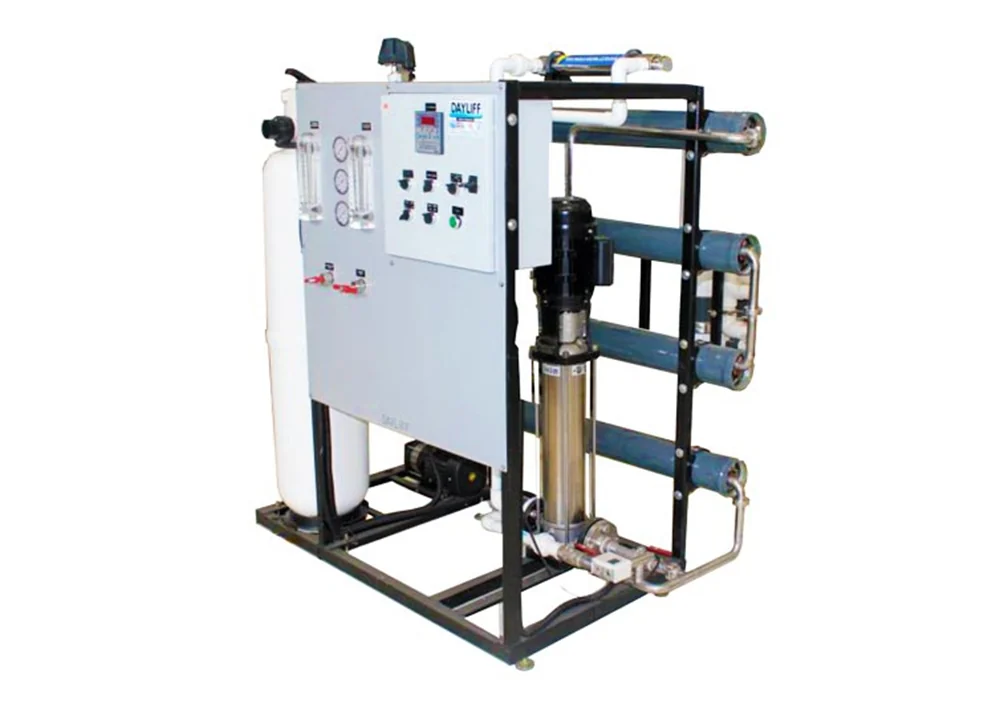
The Dayliff BRO4 range lists 250, 500 and 1,000LPH options for a lower feed-TDS envelope. The Dayliff DRO4 range covers nominal outputs from 250 to 2,000LPH, with low and medium brackish-water configurations. Matching a range to your water report matters more than choosing a familiar model name or the cheapest nominal capacity.
Hotels, schools and apartment developments also need a plan for peak use and interruptions. Decide whether the RO supply serves drinking points, kitchens or a wider distribution network. Treating every litre used for cleaning or flushing may create unnecessary cost where a separate suitable supply is available. Explain your intended connections so that the design can separate treated-water demand from other water uses.
Industrial reverse osmosis machine installation
The Dayliff DRO8 industrial range lists nominal capacities from 3,000 to 20,000LPH. Larger installations require a designed feed supply, pretreatment, electrical connection, access for maintenance and suitable product-water storage. Standard brackish-water options should not be described as seawater plants. If your water falls outside the published feed envelope, request a separately engineered configuration with a documented performance basis.
Industrial buyers should define the required product-water quality before approving the plant. A process may need additional polishing, disinfection or remineralisation after RO. Drinking-water equipment does not automatically meet dialysis, pharmaceutical or ultrapure-water requirements. Identify the applicable process specification and appoint the required specialists. The quotation should state the design assumptions and acceptance tests rather than rely on a general claim of purity.
Plan access and installation space early
Share doorway widths, floor access, available lifting arrangements and the proposed pipe routes. A plant that fits the room may still lack space to replace membranes or service a pump. Keep sampling points, instruments and valves accessible. Consider drainage during flushing and maintenance, and keep electrical equipment protected from water. These site details affect both installation cost and the time needed for future servicing.
Where you expect demand to grow, discuss modular expansion before buying the first plant. Larger feed pumps, tanks or electrical connections may be justified, but they should follow a clear plan. Ask for the cost of the current requirement and any expansion allowance separately. This keeps your immediate purchase measurable while making future changes easier to assess.
What your RO installation quotation should include
Request an itemised quotation with the machine model, capacity, design feed conditions, pretreatment and agreed site works. The machine-only prices at the beginning of this page help you set an initial budget. They do not include every laboratory test, storage tank, cable run or civil work. Compare quotations using the same scope so that a low equipment figure does not hide a larger unfinished installation.
Ask the quotation to identify delivery to your location, offloading, assembly, plumbing, electrical work, commissioning and operator training. It should state VAT treatment, payment stages, validity, expected lead time and written warranty terms. Confirm whether consumables and the first replacement filters are included. Do not assume that a warranty or installation offer advertised by a manufacturer or another supplier is part of our quotation.
Clear responsibilities reduce delays
Agree who provides the water report, raw-water feed, drainage point, power supply and prepared installation area. Confirm any landlord approval or specialist electrical work before scheduling attendance. For a working business, plan how the changeover affects production and customer service. If the existing water arrangement must keep operating, discuss the temporary supply and isolation plan before equipment arrives.
Our contact base is Kamulu, Nairobi. For sites outside Nairobi, tell us the nearest town and send a location pin. We confirm practical attendance, freight and accommodation arrangements where relevant. A county enquiry does not imply that we maintain a branch in that county. Your written quotation should show the service arrangements for the actual site.
Products needed to complete this service
The equipment list depends on your feed water and the chosen machine. Start with the RO machine catalogue and capacity comparison. Then confirm which upstream filters, tanks, pumps, valves, instruments and electrical items belong in your installation. Some machines include several of these components, so checking the bill of materials avoids paying twice or leaving an essential item out.
For a domestic system, confirm the supplied tank, faucet, housings, cartridges and membrane. Keep the references for replacements. The Dayliff Mini RO replacement service kit is an accessory for a compatible existing purifier; it is not a complete RO machine. Check cartridge dimensions, membrane connections and the model label before ordering a service kit.
Connect the treatment plant to the wider water system
For a borehole-fed project, the feed pump, storage and distribution must work together. Review borehole pump installation if the upstream system is new, or pump maintenance if supply is unreliable. Our water storage and distribution service covers the related connection discussion. Choose electrical and solar arrangements from the total plant load, not only the RO membrane rating.
Use potable-water-compatible materials where the application requires them, and keep raw and treated lines clearly identified. Allow for isolation, sampling and safe maintenance access. Ask for a labelled drawing or equipment schedule with the finished quotation. That record helps your operator order the right parts and reduces confusion when another technician services the installation later.
Commissioning, water-quality checks and handover
Commissioning should establish how the plant performs under the agreed site conditions. Record feed pressure, product and reject flows, conductivity and the operating settings for the supplied machine. Check for leaks, verify shutdown and protection functions, and follow the manufacturer’s flushing procedure. Keep those initial readings as a baseline. They make later changes in performance easier to investigate.
Agree which laboratory tests will demonstrate the intended product-water quality and where the sample will be taken. A reading at the machine outlet does not describe water after a dirty storage tank or unsuitable distribution line. Include the downstream system in the hygiene plan. For drinking-water use, follow appropriate testing and water-safety procedures before making claims to customers or users.
Give the operator a practical maintenance plan
At handover, ask for the machine manual, membrane and cartridge references, service contacts, warranty documents and a simple operating log. The operator should know which readings to record, how to stop the plant and when to seek help. Explain who can adjust pressure and recovery settings. Unrecorded changes can make a fault harder to diagnose and may damage components.
Maintenance intervals depend on actual water quality and use. Budget for filters, compatible membranes, cleaning materials, sanitisation, testing, energy and technician attendance. A drop in product flow can have several causes, including blocked pre-filters or unsuitable feed conditions. Investigate the readings before replacing expensive parts. Keep receipts and service records with the original commissioning report.
Operating costs and reject-water planning
Compare the ongoing cost per usable litre as well as the purchase price. Feed-water consumption, electricity, consumables, cleaning and downtime all affect the result. An oversized machine may cost more to install without adding value to a small daily demand. An undersized machine may run for too long and still fail to fill your tank. Use realistic demand and operating assumptions when comparing options.
Plan the reject stream before installation. Its chemistry differs from the feed, so do not automatically send it to drinking-water storage or use it on sensitive crops. Any proposed reuse depends on a separate assessment of water quality and the intended use. Confirm a suitable discharge arrangement with the relevant site and public requirements. A convenient drain route does not by itself establish suitability.
Requirements for a water-refilling business
If you intend to sell drinking water, confirm the applicable standards and approvals with KEBS and your county public-health office. Buying an RO machine does not automatically certify your business or its water. Ask how sampling, storage hygiene, packaging and ongoing records apply to your operation. Use official guidance for the current requirements and keep the equipment supplier’s role separate from regulatory approval.
For technical background, consult WHO drinking-water guidance and the Kenya Bureau of Standards. For source-water abstraction questions, use the Water Resources Authority’s water-use allocation information. These resources support planning; the supplied model’s instructions and your site assessment remain necessary.
RO installation enquiries across all 47 Kenyan counties
Send an enquiry for reverse osmosis machine installation from any Kenyan county. Choose your county service page or view the RO county coverage directory. The same verified product models are available for comparison nationally. Delivery, installation attendance and support arrangements are confirmed for your location rather than assumed from a county name.
Include the nearest town, access details and your source-water report. Water conditions vary within counties, so we do not recommend a membrane or pretend to know your water chemistry from the address. For remote sites, agree the spares and maintenance plan before purchase. A suitable system should be practical to operate and service after the installation team has left.
Related work through our sister companies
If your project also needs a borehole or wider engineering work, review Borehole Drillers Kenya and Hamiki Engineering, our sister companies. Confirm their scope and quotation separately. Keep the source-water project, pumping equipment and RO treatment interfaces clear so that every party knows the supply and quality requirements.
Ready to plan reverse osmosis machine installation? Send your county, daily water requirement and available water analysis. Tell us whether you need a domestic purifier, a commercial water-refilling plant or an industrial installation. Call +254 743 731151 or email support@boreholepumpinstallation.com. We can identify the information needed for an itemised quotation.