Pump control panels
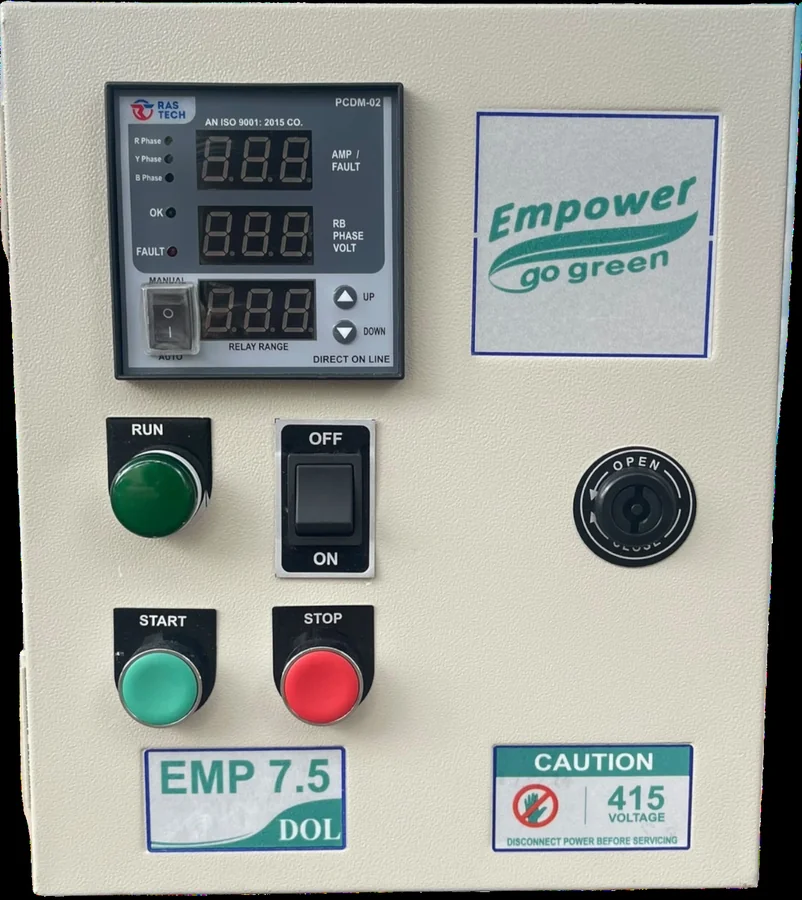
Pump control panels manage the starting, stopping and specified protection of your borehole pump motor. We supply and install panels and accessories for electric and solar pumping systems in Kenya.
Approximate cost in Kenya
Pump control panels: costs and installation scope
KSh 26,910–71,760 — The current listed Empower control-panel equipment options, from 2.2 kW to 30 kW.
KSh 35,000–110,000 — A panel with straightforward fitting, connections and testing; sensors and wiring lengths affect the total.
Allow separately: Solar pumping inverters, major electrical upgrades, long cable runs and specialist automation are separate.
Planning estimates reviewed 10 October 2026, not a fixed quotation or confirmed call-out rate. Equipment, depth of installation, access and location change the total; some projects fall outside these ranges. Confirm VAT, transport and all inclusions in your written quotation.
A pump should stop when the tank is full and respond correctly when there is insufficient source water or an electrical fault. The panel, sensors and motor must work together. Buying a box with the right kW label alone does not confirm that these functions are included.
When to book pump control panels
Use this service for a new installation, an assessed panel replacement or adding tank and borehole level control. Send the motor label, supply phase and existing controller details. For unexplained tripping, diagnosis comes before choosing a replacement panel.
What pump control panels includes
Your quotation names the panel, included protection functions, sensors, cable and installation work. After fitting, the agreed start, stop and fault responses are tested and the operator is shown the normal indications and fault-reporting procedure.
Make sure the pump starts and stops correctly
The control panel should suit the motor and the way you want the water supply to operate. Explain whether the pump fills a tank, follows a level signal or works to a different arrangement. Ask which protective functions the controller provides and which need separate sensors. A full tank should have the agreed stop response, and a fault should be recognisable to the operator. These behaviours need testing during commissioning, not just a demonstration that the motor starts.
Ask the proposal to distinguish the panel, sensors, cable and installation work. Confirm how a normal stop differs from a fault indication, who may change settings and what the operator should do when the system trips. During commissioning, the installer should check and record the relevant control behaviour against the agreed scope. A system that only works when an operator repeatedly overrides a warning needs diagnosis. Clear controls and a practical handover give the owner useful information without encouraging unqualified adjustments to electrical equipment or undocumented changes to protection settings.
Confirm mains electricity, generator or solar power
Tell us whether the property has single-phase or three-phase electricity, a generator, solar or a combination. Include the motor label and the distance from the supply point to the control panel. If the pump trips after a power interruption, mention that history. A suitable motor and correctly planned connection are essential; the quotation should show who supplies and tests the incoming electrical connection as well as the borehole equipment.
Provide photographs of the existing distribution board, motor label and controller where it is safe to obtain them without opening live equipment. Electrical measurements and alterations belong to appropriately qualified personnel. Agree who is responsible for the supply-to-panel connection, isolation, earthing, cable route and testing. A pump quotation that stops at the motor leaves important connections unresolved unless it names who will complete that work. We bring these questions into your quotation so the system proposal accounts for the route from available power to controlled water delivery.
Know whether the price includes the motor
A pump end is the section that moves the water; the motor drives it. Some listings are for the pump end only, while others are complete assemblies. Check the package before comparing prices. The selected motor must match the hydraulic end, power supply and controls, including phase and voltage. For a replacement, send both labels so the supplier can check the retained parts alongside the new component.
If you are replacing only one part of an existing assembly, send clear photographs of both the pump and motor labels. Include the reason for the replacement and any diagnostic findings. Retaining a sound component can be sensible when the match is verified, but installing a new motor against an unresolved hydraulic fault can repeat the original problem. The written quotation should distinguish the motor, pump end, complete assembly and starter so you can see what the price actually buys and which existing parts will remain in service.
Stop tank overflow and check low-water control
A float switch can signal tank level, while compatible borehole probes can help the controller respond to source-water conditions. They are different devices with different jobs. Tell us whether the problem is overflow, early stopping or failure to restart. The installer must check the controller and sensing system together. Our shop includes float switches, probe sensors and electrode accessories; the selected type and cable length follow the control design.
The quotation should state the device, cable length, mounting and any additional interface components. It should also explain the intended operating response and how the installer will check it. For an existing fault, tell us whether the pump stops too early, runs after the tank is full or fails to restart when water is required. Those patterns help frame the investigation, but they do not prove that the sensor itself has failed. Keeping sensor and controller records together makes future service more direct and reduces the temptation to bypass a useful control because its behaviour has not been understood.
Find the fault before buying replacement parts
Start with what you can observe safely: does the pump start, is there water at the usual outlet, does it stop after a few minutes, and what code appears on the controller? Note when the problem began. The cause can be in the power, control panel, cable, motor, pump, pipework or borehole. A written diagnosis helps you decide whether to repair a surface fault, lift the assembly or investigate the source.
An agreed diagnostic scope separates investigation from corrective work. Accessible checks may identify a control or delivery issue, while other findings can require retrieval or further source assessment. We do not promise that a particular part will solve a symptom before the relevant checks are complete. Request the findings and recommended options in writing. That gives you a basis for deciding whether to repair, replace or investigate further. It also helps a new component enter service with the original cause understood, rather than repeating the same fault after an apparently successful initial start.
Choose a pumping inverter that matches the motor
A solar pumping inverter controls the motor using the available solar input. Select it against the motor and array requirements, not merely the headline kW rating. Confirm input limits, output phase, motor compatibility and whether an alternative power source is supported. Our shop includes Veikong pumping inverter options. Send the actual motor label so the selected option and any mains or generator integration can be checked before purchase.
For a conversion, give us the existing motor label, controller information and evidence of its present hydraulic performance. We can then identify whether retaining the motor is a realistic option and which additional checks are needed. Where backup power or automatic changeover is requested, have the interface documented in the proposal and confirmed against manufacturer instructions. Ask for the controller settings and normal operating indications to be explained during handover. A useful solar retrofit improves the operating arrangement while preserving a clear record of what the equipment is designed to do.
Include the panels, mounting and cable in the price
A useful solar quotation identifies the module wattage and model, number of panels, electrical arrangement, mounting structure and cable route. Tell us where the panels can be mounted and whether trees or buildings cast shade. Consider security and access for cleaning as well. The mounting needs a site-appropriate design; a panel-only price does not cover the full cost of a secure, connected and working solar pumping installation.
On the physical side, identify the intended mounting area, shading, access for inspection, security and the party responsible for any supporting civil work. The quotation should specify the array, mounting arrangement and associated work clearly enough to distinguish equipment supply from a complete installation. Request module and controller records at handover and keep the final array configuration accessible. That information helps later troubleshooting, prevents undocumented changes and allows future expansion to be assessed against the installed system rather than a recollection of how many panels were originally fitted.
Budget for electrical protection and earthing
The electrical design should include suitable isolation, protective devices and earthing for the motor, controller and power source. With solar, the PV disconnect must suit the actual DC voltage and current. A lightning-arrestor product on its own is not a complete protection system. Ask for the proposed devices and electrical work to be listed, particularly where the installation is exposed or the property has a history of power-related faults.
Have appropriately qualified personnel define isolation, protective devices, earthing and the verification work. The quotation should identify what is included and what belongs to an existing upstream supply installation. For exposed or remote sites, discuss access for inspection and the practical route for reporting a fault. Retain the protection schedule with the motor and controller records. This is valuable when equipment is changed later: a replacement can alter the electrical requirements, so the old protection arrangement should be reviewed instead of simply reused because the previous pump used the same nominal kilowatt rating.
Buy the right cable size and measured length
Submersible cable runs between the motor and the control arrangement and must suit the wet environment and electrical duty. The conductor size depends on the motor, supply and full route length. Saving on an undersized cable can cause problems that cost much more to correct after lowering. Our cable prices are per metre; ask for the cable size, quantity, routing allowance and jointing materials on the same quotation.
Cable prices in this catalogue are per metre. Agree the measured length, allowance for routing and terminations, joint positions and the exact conductor and insulation specification before ordering. Before retaining an existing cable, have its condition and suitability assessed. Looking at the accessible end alone cannot establish its condition. A quotation should identify terminations and approved jointing materials alongside the main cable quantity. Include these details in the materials schedule so you can budget for necessary electrical materials alongside the equipment price.
Use a proper waterproof cable-jointing kit
A cable joint inside the borehole needs the correct waterproof system for the cable and application. Ordinary insulating tape is not a replacement for a suitable submerged joint. Our shop includes Cellpack jointing-kit options; the installer must confirm the right kit and follow its instructions. Include the kit and electrical testing in the installation price so a small omitted item does not become a hidden weakness in the system.
Do not transfer specifications from a similarly named product without verifying that it is the same kit. Ask the installer to identify the jointing material, preparation method and relevant testing in the scope. Insulating tape may be useful as a general accessory, but it is not a substitute for a properly specified submerged joint system. Good purchasing records identify the kit and show where the joint sits in the installed cable. That record can save time when later electrical testing needs to distinguish a cable fault from a motor or controller issue.
Keep surface connections secure and serviceable
The borehole headworks are where the rising main meets the delivery pipe, valves, meter and supporting arrangement. Plan accessible connections so a technician can inspect the system or lift the pump later. Tell us about leaks, damaged covers or cramped space. Select non-return valves, flange sets and water meters for the pipe, pressure and connections. Nominal diameter alone does not establish suitability.
Our catalogue includes flap non-return valves, water meters and flange sets in the listed sizes. Each needs its pressure, material and connection details confirmed for the actual supply. Matching nominal diameter alone does not prove that flange drilling or pressure classes are compatible. A useful quotation identifies included gaskets, bolts, adaptors and any separately priced civil or fabrication work. Keep a simple layout in the handover file so an operator can identify the normal delivery path and a future technician can understand how the source, meter, valves and downstream system connect.
Size the tank around actual water use
Storage helps separate the rate at which a borehole supplies water from the rate at which people use it. An apartment block may draw heavily in the morning; a solar system produces water during useful daylight hours. Share the existing tank capacity and inlet height, and explain when shortages occur. The answer may be storage, controls or distribution improvements rather than a larger source pump.
Send the tank capacity, inlet elevation, current level-control arrangement and any planned expansion. Supporting structures, foundations and building alterations need their own appropriate assessment. Check whether the pump connection price includes any of this work. Agree the boundary between borehole pumping, storage and downstream distribution. For multiple tanks or user groups, define who operates valves, monitors levels and reports faults. The resulting scope should make the whole water route understandable, including any components or works that are being provided by another contractor.
Keep a simple record of tank filling and faults
An operating log does not need to be complicated. Record the usual pumping hours, tank-filling time, controller codes and any visible leaks or unusual noise. Note whether a change followed a power interruption, pipework or an increase in users. The record helps a technician narrow the checks and compare conditions fairly. Keep observations separate from assumptions about the cause so a pump is not replaced simply because the tank is filling slowly.
The operator can keep a straightforward log without opening electrical equipment or changing protection settings. Report unusual noise, visible leaks, repeated faults or changes in water appearance through the agreed support route. The qualified service scope can then identify which measurements or inspections are required. These records are particularly valuable for systems serving several users, where a gradual loss of performance may otherwise go unnoticed until storage runs empty. Keeping the evidence with the installation file makes maintenance discussions more specific and helps distinguish source, equipment and demand changes.
Know who is doing each part of the job
A borehole project can involve the driller, pump installer, electrician, plumber and tank or civil-work contractor. Identify who provides the incoming power, trench, tank support and final connections. If you supply some equipment yourself, have the installer check it early. Clear responsibilities prevent delays on installation day and make the quotation easier to compare with the actual work completed.
If another specialist handles part of the project, share the agreed design inputs and connection requirements before ordering. The same principle applies when the owner buys equipment separately: the installer needs the actual model information and an opportunity to check the proposed match. Agree changes in quantity, route or duty in writing before changing the work. Different companies can handle parts of a coordinated scope. Each company still needs clear connection requirements and responsibilities. We help turn those connection requirements into a clear project brief for quotations and review.
Choose supply only or a complete installation
Supply only suits a buyer who already has an installer and a checked equipment list. A complete installation quotation also covers the agreed labour, materials, connections and testing. Decide which arrangement you need before comparing totals. If the old pump has failed, factor in diagnosis and lifting. If the source is unequipped, remember that a pump price alone leaves out much of the cost of getting water to the tank.
An installed option can bring those responsibilities into one agreed scope, but the proposal still needs clear boundaries. Ask whether transport, civil works, electrical supply interfaces, additional materials and operator handover are included. Where you are comparing the two routes, use the same equipment and duty basis. We can help make the differences visible so you can choose the procurement arrangement that fits the project. The decision should be based on who is responsible for the whole outcome and how it will be checked, alongside the individual product prices.
Compare pump control panels quotations on the same scope
Ask for an itemised quotation showing the exact pump, motor, control panel, pipe and cable quantities, fittings, labour and commissioning. With solar, include panels, inverter, mounting and protection. Then check transport, VAT, trenching and electrical connections. A lower total can simply mean that important items are missing. Comparing the same requirements makes it easier to choose value for money and agree the full bill before work starts.
Confirm tax treatment, delivery or collection, payment stages, availability and the written warranty route before accepting the order. Compare proposals using the same duty and included work. One quotation may cover a pump end only while another includes a motor, controls, cable and commissioning. Another may exclude civil work or the supply-to-panel connection. Request those differences in plain language. Your approved scope should name the supplied equipment, the installer’s work and your own responsibilities. It should also explain how you approve changes if the assessment reveals additional work.
What changes the cost of pump control panels?
The main price drivers are the selected pump and motor, installed depth, pipe and cable quantities, power arrangement and access for the work. A longer cable run or a higher tank can change both the materials and equipment selection. For solar, panel capacity, mounting and the pumping inverter also affect the total. Tell us whether the price you need is supply only, installation labour or a complete working system.
Use the approximate range near the start of this page as an initial budget. The written quotation confirms your actual quantities and work. Compare cable prices per metre, drop pipe prices per supplied length, and accessory prices per piece or set, using the units stated in the shop. Confirm the physical pipe length before calculating the number required. Ask whether the price includes VAT, transport, lifting equipment, trenching and commissioning. Keep a separate allowance for tanks, towers, treatment or a new power connection unless the quotation lists them. Larger or difficult installations may cost more than the indicative range; the equipment and measured work should explain why.
Plan pump control panels for your county and site
A location pin, contact person and access details help us prepare a realistic delivery or installation quotation. Tell us about rough access roads, narrow gates, restricted working hours and space to unload pipes or lifting equipment. For an occupied apartment block or school, agree the water-interruption window. These practical details affect travel, equipment and time on site, so share them before booking the visit.
Our contact base is Kamulu, Nairobi, and enquiries are welcome from all forty-seven Kenyan counties. County planning pages help collect the right information; they do not represent a separate branch or a guaranteed attendance time. Confirm travel, delivery and scheduling for your actual project before booking. The aim is to arrive with an agreed scope and the correct equipment information, while acknowledging any assessment still needed on site. Clear access details also help distinguish a price for collection from a delivered price and from a complete installation commitment.
Pump control panels: check delivery before sign-off
Commissioning checks the installed system against the agreed job. Ask for measured delivery at the stated point, relevant electrical checks and a demonstration of the controls. Water at the borehole outlet is different from water reaching a distant tank. Record the model, pump setting, cable and pipe details and test results. These readings become the reference for future service if tank-filling time or output changes.
Ask the installer to explain the test results and any limitations at handover. If measurements differ from the expected performance, ask the installer to investigate the findings and explain the next step. A running pump alone does not confirm the agreed delivery. The acceptance location also matters: delivery at the headworks is different from delivery at a distant tank inlet. Keep the commissioning record with the source documents and quotation. It becomes a useful baseline for later maintenance, helps identify changes in source or delivery conditions and makes future equipment decisions easier to check.
Pump control panels records and operating instructions
Before the team leaves, make sure the person who will run the system understands the normal start, stop and fault indications. Keep the invoice, installed models, serial numbers, test results and written warranty terms together. For shared property, give the caretaker access to the service contact and agreed operating instructions. A clear handover saves time during maintenance and helps you distinguish existing equipment from parts supplied during the new work.
Keep the invoice and written warranty terms with the model and serial numbers. Ask the supplier to confirm the warranty scope, provider, duration and exclusions for the actual equipment. A website brand mention does not establish warranty cover. If the project retains old equipment, mark it clearly in the handover schedule. If the installer recommends further assessment or follow-up, record the reason and who will handle it. This approach gives the owner an installation file that remains useful after the technicians leave and supports a more direct conversation when another service visit becomes necessary.
Keep the borehole and water-use records in order
Keep the borehole completion report, pumping-test information and applicable water-use authorisation with the project documents. Kenya’s Water Resources Authority provides the official guidance on abstraction requirements. Buying a larger pump does not itself allow a higher abstraction rate. For electrical and solar work, confirm the applicable professional requirements using EPRA resources and appoint appropriately qualified people for the actual installation.
For solar and electrical work, use appropriately qualified personnel and verify the applicable professional requirements through the official Energy and Petroleum Regulatory Authority resources. The quotation should assign responsibility for permits, electrical interfaces and specialist assessments where needed. Use the official resources below to obtain current guidance directly. Manufacturer instructions and site-specific assessment remain necessary alongside those public requirements; neither a catalogue price nor a service page is a substitute for an approved project design.
Questions about pump control panels
How much should I budget for this service?
As an initial guide, allow KSh 26,910–71,760 for the current listed Empower control-panel equipment options, from 2.2 kW to 30 kW. A second allowance is KSh 35,000–110,000 for a panel with straightforward fitting, connections and testing; sensors and wiring lengths affect the total. These are planning figures, not a fixed quotation. Confirm VAT, travel, materials and all included work for your site.
What do I need to send for a quotation?
Send your county, nearest town, location pin, daily water requirement and available borehole or equipment records. For an existing system, include clear pump, motor and controller labels and a description of the fault or work required. Tell us what information is missing.
Can you supply the products and install them?
You can request equipment supply only or a quotation including the agreed installation work. The quotation lists the exact models, quantities, labour and testing so you can see what the total covers. We check compatibility before selecting equipment.
Can I get an estimate before a site visit?
Yes. The range at the top of this page is a starting budget. Share the available records and photos for an initial review. If your project needs measurements or diagnosis, agree the assessment charge and the next step before booking.
Do you handle projects outside Nairobi?
Send your enquiry from any of Kenya’s 47 counties. Our contact base is Kamulu, Nairobi. We confirm travel, delivery and the practical installation or service arrangements for your location before booking.
What about stock, warranty and payment?
Confirm the selected equipment, availability, delivery time, written warranty terms and payment stages in your quotation. Keep the invoice, model and serial numbers and handover record together for later support.
Manufacturer and official resources
Use these resources for current requirements and equipment guidance. The documentation for the exact supplied model and a site-specific assessment remain the basis for the work.
- Franklin Electric — application, installation and maintenance resources
- Grundfos — pump selection and sizing principles
- Water Resources Authority — water-use allocation and permitting
- EPRA — renewable-energy licensing guidance
Our sister companies
For related work outside the agreed pumping scope, contact Borehole Drillers Kenya or Hamiki Engineering. Confirm their scope and quotation separately.
Get a quotation for your borehole
Send your location pin, water requirement and available equipment or borehole records. Tell us whether you need supply only, installation, repair or conversion, and we will help identify the next step for your quotation. Call +254 743 731151 or email support@boreholepumpinstallation.com.
Review installation price factors · Find your county · Compare all services