Borehole pump installation
Borehole pump installation turns your drilled source into a working water supply for your home, rental property, farm or institution. Now get the water to your tank. We supply and install a matched submersible pump, motor, pipes, cable and controls for homes, rental properties, farms and institutions in Kenya.
Approximate cost in Kenya
Borehole pump installation costs and inclusions
KSh 30,000–80,000 — Installation labour and commissioning, where suitable equipment is already available.
KSh 180,000–450,000 — A small to medium electric installation with pump and motor, controls, rising main, cable and installation.
Allow separately: Drilling, a new tank, tank tower, major trenching and a new electricity connection are separate.
Planning estimates reviewed 10 October 2026, not a fixed quotation or confirmed call-out rate. Equipment, depth of installation, access and location change the total; some projects fall outside these ranges. Confirm VAT, transport and all inclusions in your written quotation.
A successful installation starts with the pumping-test report, not just the number of metres drilled. We use the water level, available yield and tank height to select equipment that can do the job. You receive an itemised quotation showing the pump, materials and installation work before you commit.
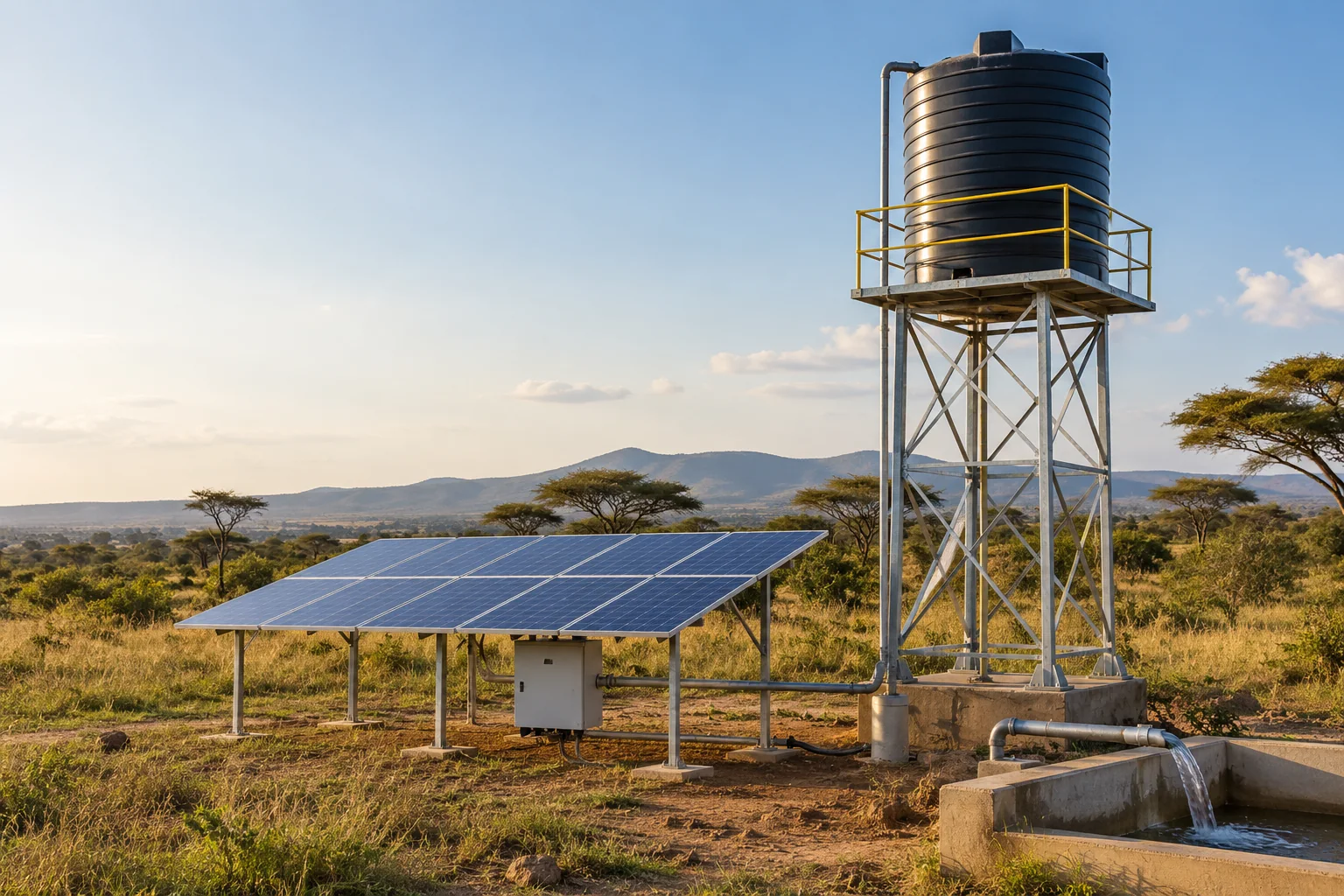
When to book borehole pump installation
Book this service for an unequipped borehole or a complete new pumping installation. If you already bought the equipment, send the labels and quantities so suitability can be checked before the installation day. For a borehole that has stopped working, start with our repair service.
What borehole pump installation includes
The aim is water delivered to the agreed point, with the controls tested and the operator shown how to use the system. Your quotation identifies the equipment supplied, pipe and cable lengths, labour, testing and any work needed before installation.
Use your borehole report to choose the right pump
Keep the drilling completion report and pumping-test report together. They tell the pump supplier more than the drilled depth on its own. The water level while pumping, tested discharge and recommended operating conditions help establish what the source can support. For an older borehole in use, share recent tank-filling times and any change in output as well. If the driller holds the report, request a copy before ordering equipment.
We use the records to frame the questions that need answering, rather than promise a result from a depth figure alone. Tell us the date of the latest pumping test, whether demand has changed and whether recent operation differs from the original report. A borehole supplying one household may later serve rental units, livestock or irrigation. That change deserves a fresh demand and duty discussion, even if the old pump still starts. Keep the accepted design basis with the equipment quotation so future maintenance starts from the same facts.
Work out how much water you need each day
Start with litres per day and who will use the water. A family home, a block of rental units and a dairy farm have different demand patterns. For irrigation, include the crop, area, watering method and schedule. For apartments, include the number of occupied units and shared uses. Tell us how much storage is available and when the tanks need to be full; that makes a more useful buying brief than simply asking for the biggest pump.
Give us the current tank capacity, expected future users and the hours during which pumping is practical. For a school, explain term-time demand; for a farm, describe the crop and watering schedule; for rental property, identify shared and private storage. We can then discuss a scope that connects abstraction, pumping and storage. Buying the largest available motor is not a substitute for this brief. The practical target is an agreed water-delivery duty that the source and selected equipment can support, with operating duties the owner can understand.
Will the pump deliver water to your tank?
The pump must lift water from the pumping water level and deliver it through the pipework to the agreed outlet. A raised tank, uphill plot or long delivery line adds to the duty. That is why two boreholes drilled to the same depth can need different pumps. Share the tank inlet height and route from the borehole. The selection should show the required flow at the total pumping head, rather than unrelated maximum-flow and maximum-head figures.
Send a simple site sketch showing the source, tank, approximate route, changes in elevation and any existing pipe sizes. The agreed assessment can refine these measurements. Ask the supplier to mark the proposed operating point on the curve for the exact pump model. A maximum-head figure and a maximum-flow figure are not a promise that both occur together. Clear duty information also helps compare quotations: two differently priced pumps may be designed for different jobs, while two equal-kilowatt pumps may have very different hydraulic performance.
Compare pump performance, not horsepower alone
A 2 HP pump is not automatically a substitute for another 2 HP pump. The number of stages and hydraulic design affect the flow each can deliver at your pumping head. Ask for the full model code and the matching performance curve. Compare both options at the same required flow and head. This helps you avoid paying for a pump that looks powerful on paper but cannot fill the tank as intended.
For listed pump ends, remember that the hydraulic assembly is not necessarily a complete pump-and-motor package. Confirm the motor, coupling, control arrangement and included accessories separately. For a replacement, an apparently similar model number is not enough to prove compatibility with the retained parts. We help organise the product information into a proposal that names the exact option and its supporting equipment. Where the source documentation does not establish a numerical specification, the quotation should obtain it instead of presenting an estimate as a manufacturer guarantee.
Check that the pump will fit and can be lifted later
Confirm the actual clear inside diameter of the borehole casing before buying the submerged assembly. The pump, motor, cable and joints all need room. Share the completion report and any history of obstructions or difficult lifting. At the surface, keep enough access for installation and future retrieval. A permanent structure, parking obstruction or tightly enclosed pump house can turn a straightforward replacement into a more expensive job.
For existing systems, provide the old pump setting, pipe type, cable details and photographs of the headworks. Tell us about previous retrieval problems before new equipment is booked. The scope should identify what is known, what requires inspection and how an unexpected obstruction would be handled. This helps avoid treating a straightforward supply quotation as a commitment to work that has not been assessed. A good installation remains serviceable after handover, so clearance and access should be considered alongside the immediate need to lower the equipment.
Know whether the price includes the motor
A pump end is the section that moves the water; the motor drives it. Some listings are for the pump end only, while others are complete assemblies. Check the package before comparing prices. The selected motor must match the hydraulic end, power supply and controls, including phase and voltage. For a replacement, send both labels so the supplier can check the retained parts alongside the new component.
If you are replacing only one part of an existing assembly, send clear photographs of both the pump and motor labels. Include the reason for the replacement and any diagnostic findings. Retaining a sound component can be sensible when the match is verified, but installing a new motor against an unresolved hydraulic fault can repeat the original problem. The written quotation should distinguish the motor, pump end, complete assembly and starter so you can see what the price actually buys and which existing parts will remain in service.
Confirm mains electricity, generator or solar power
Tell us whether the property has single-phase or three-phase electricity, a generator, solar or a combination. Include the motor label and the distance from the supply point to the control panel. If the pump trips after a power interruption, mention that history. A suitable motor and correctly planned connection are essential; the quotation should show who supplies and tests the incoming electrical connection as well as the borehole equipment.
Provide photographs of the existing distribution board, motor label and controller where it is safe to obtain them without opening live equipment. Electrical measurements and alterations belong to appropriately qualified personnel. Agree who is responsible for the supply-to-panel connection, isolation, earthing, cable route and testing. A pump quotation that stops at the motor leaves important connections unresolved unless it names who will complete that work. We bring these questions into your quotation so the system proposal accounts for the route from available power to controlled water delivery.
Choose drop pipes for pressure and suspended load
The rising main carries water up the borehole and forms part of the suspended installation. Its material, pressure rating, joints and load capability must suit the pump setting and duty. A pipe of the right diameter can still be unsuitable for the job. Compare the specified drop-pipe system with the cheaper-looking alternative before ordering. Surface HDPE delivery pipe has a different role. List it separately in the bill of quantities.
Our pipe catalogue identifies nominal sizes and the pressure designations supplied on the list. Prices are shown per pipe length, with the actual physical length and coupling details confirmed in the quotation. Ask the proposal to state the total measured quantity and any separately priced fittings or adaptors. For retained pipework, inspection findings should determine what can be reused. The rising main and the surface delivery line may have different requirements. Itemise their materials, quantities and installation work separately. This makes both the purchase and any future maintenance easier to understand.
Buy the right cable size and measured length
Submersible cable runs between the motor and the control arrangement and must suit the wet environment and electrical duty. The conductor size depends on the motor, supply and full route length. Saving on an undersized cable can cause problems that cost much more to correct after lowering. Our cable prices are per metre; ask for the cable size, quantity, routing allowance and jointing materials on the same quotation.
Cable prices in this catalogue are per metre. Agree the measured length, allowance for routing and terminations, joint positions and the exact conductor and insulation specification before ordering. Before retaining an existing cable, have its condition and suitability assessed. Looking at the accessible end alone cannot establish its condition. A quotation should identify terminations and approved jointing materials alongside the main cable quantity. Include these details in the materials schedule so you can budget for necessary electrical materials alongside the equipment price.
Use a proper waterproof cable-jointing kit
A cable joint inside the borehole needs the correct waterproof system for the cable and application. Ordinary insulating tape is not a replacement for a suitable submerged joint. Our shop includes Cellpack jointing-kit options; the installer must confirm the right kit and follow its instructions. Include the kit and electrical testing in the installation price so a small omitted item does not become a hidden weakness in the system.
Do not transfer specifications from a similarly named product without verifying that it is the same kit. Ask the installer to identify the jointing material, preparation method and relevant testing in the scope. Insulating tape may be useful as a general accessory, but it is not a substitute for a properly specified submerged joint system. Good purchasing records identify the kit and show where the joint sits in the installed cable. That record can save time when later electrical testing needs to distinguish a cable fault from a motor or controller issue.
Make sure the pump starts and stops correctly
The control panel should suit the motor and the way you want the water supply to operate. Explain whether the pump fills a tank, follows a level signal or works to a different arrangement. Ask which protective functions the controller provides and which need separate sensors. A full tank should have the agreed stop response, and a fault should be recognisable to the operator. These behaviours need testing during commissioning, not just a demonstration that the motor starts.
Ask the proposal to distinguish the panel, sensors, cable and installation work. Confirm how a normal stop differs from a fault indication, who may change settings and what the operator should do when the system trips. During commissioning, the installer should check and record the relevant control behaviour against the agreed scope. A system that only works when an operator repeatedly overrides a warning needs diagnosis. Clear controls and a practical handover give the owner useful information without encouraging unqualified adjustments to electrical equipment or undocumented changes to protection settings.
Keep surface connections secure and serviceable
The borehole headworks are where the rising main meets the delivery pipe, valves, meter and supporting arrangement. Plan accessible connections so a technician can inspect the system or lift the pump later. Tell us about leaks, damaged covers or cramped space. Select non-return valves, flange sets and water meters for the pipe, pressure and connections. Nominal diameter alone does not establish suitability.
Our catalogue includes flap non-return valves, water meters and flange sets in the listed sizes. Each needs its pressure, material and connection details confirmed for the actual supply. Matching nominal diameter alone does not prove that flange drilling or pressure classes are compatible. A useful quotation identifies included gaskets, bolts, adaptors and any separately priced civil or fabrication work. Keep a simple layout in the handover file so an operator can identify the normal delivery path and a future technician can understand how the source, meter, valves and downstream system connect.
Compare borehole pump installation quotations on the same scope
Ask for an itemised quotation showing the exact pump, motor, control panel, pipe and cable quantities, fittings, labour and commissioning. With solar, include panels, inverter, mounting and protection. Then check transport, VAT, trenching and electrical connections. A lower total can simply mean that important items are missing. Comparing the same requirements makes it easier to choose value for money and agree the full bill before work starts.
Confirm tax treatment, delivery or collection, payment stages, availability and the written warranty route before accepting the order. Compare proposals using the same duty and included work. One quotation may cover a pump end only while another includes a motor, controls, cable and commissioning. Another may exclude civil work or the supply-to-panel connection. Request those differences in plain language. Your approved scope should name the supplied equipment, the installer’s work and your own responsibilities. It should also explain how you approve changes if the assessment reveals additional work.
What changes the cost of borehole pump installation?
The main price drivers are the selected pump and motor, installed depth, pipe and cable quantities, power arrangement and access for the work. A longer cable run or a higher tank can change both the materials and equipment selection. For solar, panel capacity, mounting and the pumping inverter also affect the total. Tell us whether the price you need is supply only, installation labour or a complete working system.
Use the approximate range near the start of this page as an initial budget. The written quotation confirms your actual quantities and work. Compare cable prices per metre, drop pipe prices per supplied length, and accessory prices per piece or set, using the units stated in the shop. Confirm the physical pipe length before calculating the number required. Ask whether the price includes VAT, transport, lifting equipment, trenching and commissioning. Keep a separate allowance for tanks, towers, treatment or a new power connection unless the quotation lists them. Larger or difficult installations may cost more than the indicative range; the equipment and measured work should explain why.
Plan borehole pump installation for your county and site
A location pin, contact person and access details help us prepare a realistic delivery or installation quotation. Tell us about rough access roads, narrow gates, restricted working hours and space to unload pipes or lifting equipment. For an occupied apartment block or school, agree the water-interruption window. These practical details affect travel, equipment and time on site, so share them before booking the visit.
Our contact base is Kamulu, Nairobi, and enquiries are welcome from all forty-seven Kenyan counties. County planning pages help collect the right information; they do not represent a separate branch or a guaranteed attendance time. Confirm travel, delivery and scheduling for your actual project before booking. The aim is to arrive with an agreed scope and the correct equipment information, while acknowledging any assessment still needed on site. Clear access details also help distinguish a price for collection from a delivered price and from a complete installation commitment.
Borehole pump installation: check delivery before sign-off
Commissioning checks the installed system against the agreed job. Ask for measured delivery at the stated point, relevant electrical checks and a demonstration of the controls. Water at the borehole outlet is different from water reaching a distant tank. Record the model, pump setting, cable and pipe details and test results. These readings become the reference for future service if tank-filling time or output changes.
Ask the installer to explain the test results and any limitations at handover. If measurements differ from the expected performance, ask the installer to investigate the findings and explain the next step. A running pump alone does not confirm the agreed delivery. The acceptance location also matters: delivery at the headworks is different from delivery at a distant tank inlet. Keep the commissioning record with the source documents and quotation. It becomes a useful baseline for later maintenance, helps identify changes in source or delivery conditions and makes future equipment decisions easier to check.
Borehole pump installation records and operating instructions
Before the team leaves, make sure the person who will run the system understands the normal start, stop and fault indications. Keep the invoice, installed models, serial numbers, test results and written warranty terms together. For shared property, give the caretaker access to the service contact and agreed operating instructions. A clear handover saves time during maintenance and helps you distinguish existing equipment from parts supplied during the new work.
Keep the invoice and written warranty terms with the model and serial numbers. Ask the supplier to confirm the warranty scope, provider, duration and exclusions for the actual equipment. A website brand mention does not establish warranty cover. If the project retains old equipment, mark it clearly in the handover schedule. If the installer recommends further assessment or follow-up, record the reason and who will handle it. This approach gives the owner an installation file that remains useful after the technicians leave and supports a more direct conversation when another service visit becomes necessary.
Keep the borehole and water-use records in order
Keep the borehole completion report, pumping-test information and applicable water-use authorisation with the project documents. Kenya’s Water Resources Authority provides the official guidance on abstraction requirements. Buying a larger pump does not itself allow a higher abstraction rate. For electrical and solar work, confirm the applicable professional requirements using EPRA resources and appoint appropriately qualified people for the actual installation.
For solar and electrical work, use appropriately qualified personnel and verify the applicable professional requirements through the official Energy and Petroleum Regulatory Authority resources. The quotation should assign responsibility for permits, electrical interfaces and specialist assessments where needed. Use the official resources below to obtain current guidance directly. Manufacturer instructions and site-specific assessment remain necessary alongside those public requirements; neither a catalogue price nor a service page is a substitute for an approved project design.
Questions about borehole pump installation
How much should I budget for this service?
As an initial guide, allow KSh 30,000–80,000 for installation labour and commissioning, where suitable equipment is already available. A second allowance is KSh 180,000–450,000 for a small to medium electric installation with pump and motor, controls, rising main, cable and installation. These are planning figures, not a fixed quotation. Confirm VAT, travel, materials and all included work for your site.
What do I need to send for a quotation?
Send your county, nearest town, location pin, daily water requirement and available borehole or equipment records. For an existing system, include clear pump, motor and controller labels and a description of the fault or work required. Tell us what information is missing.
Can you supply the products and install them?
You can request equipment supply only or a quotation including the agreed installation work. The quotation lists the exact models, quantities, labour and testing so you can see what the total covers. We check compatibility before selecting equipment.
Can I get an estimate before a site visit?
Yes. The range at the top of this page is a starting budget. Share the available records and photos for an initial review. If your project needs measurements or diagnosis, agree the assessment charge and the next step before booking.
Do you handle projects outside Nairobi?
Send your enquiry from any of Kenya’s 47 counties. Our contact base is Kamulu, Nairobi. We confirm travel, delivery and the practical installation or service arrangements for your location before booking.
What about stock, warranty and payment?
Confirm the selected equipment, availability, delivery time, written warranty terms and payment stages in your quotation. Keep the invoice, model and serial numbers and handover record together for later support.
Manufacturer and official resources
Use these resources for current requirements and equipment guidance. The documentation for the exact supplied model and a site-specific assessment remain the basis for the work.
- Franklin Electric — application, installation and maintenance resources
- Grundfos — pump selection and sizing principles
- Water Resources Authority — water-use allocation and permitting
- EPRA — renewable-energy licensing guidance
Our sister companies
For related work outside the agreed pumping scope, contact Borehole Drillers Kenya or Hamiki Engineering. Confirm their scope and quotation separately.
Get a quotation for your borehole
Send your location pin, water requirement and available equipment or borehole records. Tell us whether you need supply only, installation, repair or conversion, and we will help identify the next step for your quotation. Call +254 743 731151 or email support@boreholepumpinstallation.com.
Review installation price factors · Find your county · Compare all services